Home Chi sono Tutte le ricette. Più o meno in ordine Fonti di ispirazione Vuoi scrivermi? English Version
Showing posts with label jams. Show all posts

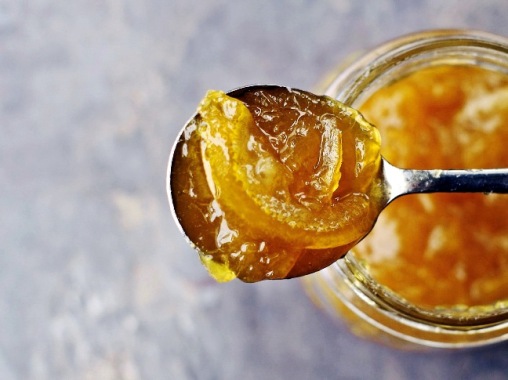
Orange Marmalade

Thursday, April 28, 2011
Orange Marmalade

Citrus Week, Part Three.
On orange marmalade, the world seems to be split in half: either you love it or you hate it, no shades of gray. I belong to the first group, so much that I keep making it again and again more or less every year, as soon as the jars in my pantry start to drop below the alarm threshold.
Say what you'd like, but orange marmalade, made as it should be, with all the pieces of skin in, that thick, stout, and super aromatic marmalade, besides giving you the illusion of being a bit British, it also makes you happy that it’s still winter.
Ok, maybe I'm exaggerating. Maybe it won't make you forget the cold, but for sure it alleviates some of the pain.


Orange Marmalade
for about 10 medium jars

thick-skinned navel oranges, organic 8
organic lemons 2
sugar depending on the weight of the fruit
water as needed


The recipe comes one more time from the forum of La Cucina Italiana (oh, hi forum!), it was the first jam I've ever tried, and I always make it in the same way because I find it really good. I admit you must arm yourselves with a bit of patience, as the process is quite long, although actual working time is the same as any other jam. Basically you just need to leave the oranges to soak in water for a few days, and they do everything by themselves. You can sleep sweet dreams.

First of all weigh oranges and lemons, whole, and pour as much water as their weight in a large pot. Wash fruit thoroughly, remove the colored layer of their skin with a potato peeler, cut it into strips and add it to water. Do the same with the white part. Remove the seeds, cut citrus in small pieces, and add them to the water as well. Cover the pot and let macerate for 24 hours. After this time, put on the stove and cook gently until the orange peel becomes very tender (it'll take about an hour and a half). Turn off the heat, cover again and let macerate for another 24 hours.
Now weigh the fruit-and-water mixture, and add 70% of the weight in sugar (the original recipe calls for an equal amount of sugar, but to me less than that is fine). Cook over low heat, stirring frequently and skimming if necessary. When marmalade reaches the desired consistency, pour it into clean, sterilized glass jars. Close them tightly, place them in a large pot full of water, and let them boil for 20 minutes. Turn off the heat and let the jars cool in the same water to create the vacuum.


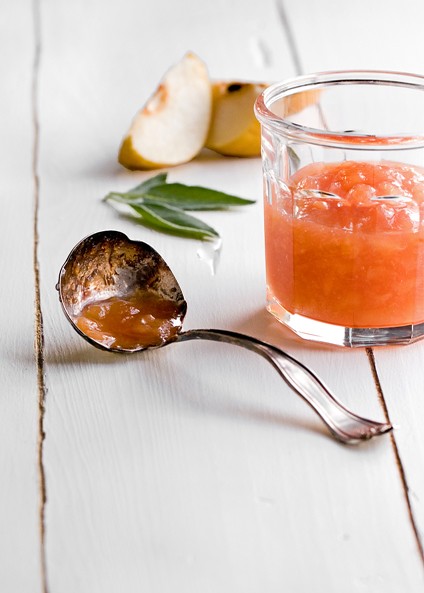
Pear Jam

Pear Jam with Chestnut Honey & Sage

It's been a while since last time I made jams and marmalade. This year, summer inexplicably went by without leaving any trace between my cupboard's jars. An unforgivable mistake, indeed.
Inspiration magically came to me when I laid my eyes on, ehm...no, when I took possession of this thing here. Finally a book on jam making worthy of Christine Ferber, a 372-page volume full of irresistible colors and fragrance, a true ode to fruit, with a slightly retro style that won my heart.
Blue Chair Fruit is a fairly famous name here, some sort of cult for all those who happily hang out at farmers markets and specialty bakeries on Saturday mornings, a love song for the simplest of all breakfasts, a celebration of local and seasonal products, and yet another embodiment of the American dream.
Ok, I have to admit I'm a little biased, but trust me for now, and then, when you happen to be around here, I'll reward you with a tour de force on the streets of San Francisco, hunting for meyer lemons, early girl tomatoes, pluots and cranberries.
It's a done deal!


Pear Jam
with Chestnut Honey & Sage

for 3 medium jars

ripe pears, net 1,300 gr.
(I used Asian pears)
sugar 400 gr.
lemons 2
chestnut honey 1 tablespoon
apple cider vinegar 1-2 teaspoons
fresh sage leaves 5-6


Peal and core pears, and cut them in small cubes. Add sugar and juice of lemons, and mix well. Cover with plastic and refrigerate overnight.
The next day, pour everything in a large pot and bring to boil, stirring every once in a while. Let it cook for about 20 minutes, then puree about 1/3 of the mixture. Pour it back in the pot and keep cooking for another 20-30 minutes, or until jam reaches desired consistency, skimming when necessary. Add apple cider vinegar and one tablespoon of chestnut honey, stir well and cook for 1-2 minutes longer. Turn off the heat, add sage leaves, previously washed and pat dry, and let them sit for about 6-7 minutes (don't worry, their taste will become less intense once jam cools down). Discard sage, then pour the jam in cleaned and properly sterilized glass jars. Cover with lids, place the jars in a pot of boiling water, and boil for 20 minutes. Turn off the heat and let the jars cool off in the same water to create vacuum.

Inspired by Pear Jam With Chestnut Honey & Sage, The Blue Chair Jam Cookbook, by R. Saunders

Preserved Cherries

Preserved Cherries

When life gives you lemons, make lemonade.

When life gives you lemons, make lemonade (... but, what about a limoncello instead?). When life throws you tomatoes, make marinara sauce. If they're apples, then strudel. And when life gives you cherries, you listen to me. Place them tight in a jar, a few tablespoons of sugar and then forget about them until the fall. I promise you, when the days will get dark and cold, the sky will become gray with clouds, and baby blue flip flops will be only a vague memory, to the lemons of life you'll be able to reply with a spoonful of syrup.
I.P. (Intense Pleasure).

May the cherry be with you.


Preserved Cherries


This recipe has been was the virtual obsession of a May of three years ago, and I totally owe my initiation to Clelia, a friend from the CI forum (online forum of the Cucina Italiana Magazine, ed). I remember that spring very well, 'cause a little afterwards I would have gone home for two months full of sunshine and vacation days. Call it Intense Pleasure.... And the cherries! In the meantime they were sitting there working for me, and coming back I would find them juicy and perfectly alcoholic, the right antidote to the slight nostalgia of the return.

Nothing simpler than this: get some ripe and firm cherries, wash them and pat them dry. Arrange them in layers in previously sterilized glass jars, alternating with spoonfuls of sugar (the amount of sugar will be more or less half of that of the cherries). Close the jars and place them in the pantry in a cool, dark place. Every now and then give them a good shake, or turn the jars upside down every other week (in this case, be careful, because the syrup will tend to come out).
Let the cherries macerate more or less until October. A thick syrup will form, and the cherries will become slightly alcoholic. You can use them on ice cream, to pair chocolate desserts, or just as they are, one by one straight from the jar. And the syrup.... call it Intense Pleasure!

Strawberry Rhubarb Jam

Strawberry Rhubarb Jam

Not all rhubarb is an ill wind. And not all rhubarb ends up in Rabarbaro Zucca (popular Italian aperitif, A/N). If you can find it on the produce store shelves, take advantage of it, until there's time.
You'll be surprised, at least I was.


Strawberry Rhubarb Jam
strawberries, net 1.5 kg
rhubarb, net 1 kg
(I would have liked to use the same weight as the strawberries, but I've stolen all I could find at the produce store and I didn't have more than this)
sugar 1 kg
juice of two lemons


Wash strawberries and cut them in pieces. Put them in a bowl and mix them with 500 gr. sugar and juice of one lemon. Wash rhubarb, discard filaments and cut it in small pieces. Put it in a different bowl and mix it with 500 gr. sugar and juice of the other lemon. Cover with plastic and let macerate in the fridge overnight.
The next day cook rhubarb and strawberry mixtures separately with their own juices, skimming when necessary. When both jams reach the right consistency, mix them in one pot, cook for few more minutes, then pour in glass jars and can them as usual.

Note: as I mentioned above, you can add more rhubarb, using an equal amount as the strawberries (and increasing the amount of sugar, proportionally). It'll be for next year : )

Meyer lemon Marmalade

Wednesday, April 27, 2011
Meyer Lemon Marmalade

If you happen to be in California during winter months, don't think it twice and stock up on meyer lemons. Trust me, they are worth as much as a walk on Hollywood Hall of Fame or a visit to Beverly Hills.
Wikipedia tells us that these lemons are originally from China, where they're used as an ornamental plant, and they were introduced in California in the beginning of last century by Frank Meyer, an employee of the Department of Agriculture, from whom they've gotten their name.
I can also tell you that meyer lemons are somewhat in between a lemon and a mandarin, their skin is thinner than common lemons, they are sweet and incredibly scented.
Saturday morning my usual trip to the Farmers' Market should have been harmless, but these lemons were all over the place and I couldn't resist. My inner Grandma Duck woke up one more time all of a sudden and she didn't want to listen to reason. Thus, you get this one.


Meyer Lemon Marmalade

meyer lemons
water
sugar


A recipe somewhat minimalist, you may say, but quantities depend on the amount and size of lemons. I used 10 of them.
Wash lemons, cut off the ends, then cut them in half lenghtwise. Take out the seeds and keep them aside. Cut each lemon half in thin slices, and put them in a large bowl, collecting all the juice they might have released. Barely cover with water and refrigerate overnight.
The next day, weight lemon-water mixture and add approximately 70% of the weight in sugar (I've used 1,5 kg o sugar for 2,2 kg. of sugar and water).
Wrap the reserved seeds with a piece of cheesecloth, tying it like a small satchel. Add the cheesecloth to a pot along with the fruit, water and sugar, and let it simmer over low-medium heat, skimming if necessary. When the marmalade reaches the right thickness, discard the cheesecloth and pour it in properly cleaned and sterilized glass jars. Close them tightly, put them in a large pot filled with water, and let them boil for 20 minutes. Turn off the heat, and let the jars cool off in the same water to create the vacuum.

Cranberry Orange Jam

Cranberry Orange Jam

Cranberries are here, and I mean the real ones! After putting up with the dried ones for 10 months, in muffins, quick breads and more or less yummy salads, and after drinking liters of them in a juice form, finally here they come to the produce stores' shelves, plain and simple, just like Nature originally conceived them.
So forgive me, but now you'll have to put up with this jam. And if you don't find them in Italy, is this my fault?


Cranberry Orange Jam

fresh cranberries 1,200 gr.
sugar 700 gr.
granny smith apples 3
lemons 3
oranges 3
cinnamon, nutmeg to taste


Peel the apples and reserve their skin, drizzling it with some lemon juice.
Cut them in small cubes and mix them with cranberries, sugar, juice from the lemons, juice and grated peel from the oranges. Cover and refrigerate overnight.
The next day, cook the fruit mixture adding the spices and the reserved apple peel, which will be discarded in the end. Cook at low-medium heat, skimming when needed.
When the jam reaches the desired thickness, pour it in the previously sterilized glass jars, seal them and let them boil, covered with water, for 20 minutes.
Turn off the heat and let them cool in the same water to create the vacuum.
Lychee Jam

Lychee Jam with Raspberries and Rose Water

Ok, ok, I know, I am a little late with the post. This one is a slightly disconnected post... Because in reality I made this jam few weeks ago, after buying the last available lychees from a produce store in Chinatown. And instead of fixing myself a martini, I decided to throw them in the pan.

Needless to say, I freely adapted this recipe from Christine Ferber's book again. How boring.


Lychee Jam
with Raspberries & Rose Water


lychee, peeled and pitted 2 and 1/4 lb.
raspberries 1 lb.
sugar 1 lb.
lemon 2
rose water 1 and 1/2 ounces
green apple 2


Peel and pit the lychees. Cut them in pieces and put them in a bowl with raspberries, juice from the lemons and sugar. Cover with plastic and let it rest in the fridge overnight.
The next day, place the fruit mixture in a large pot, add the peel from the apples and bring it to boil, skimming when needed. Few minutes before the jam reaches the desired thickness, add rose water and stir well.
Discard the apple peel, pour the jam in cleaned and sterilized glass jars, cover with lid and let them boil in a large pot full of water for 20 minutes. Turn off the heat and let the jars cool in the same water to create vacuum.

Kumquat Jam

Kumquat Jam with Apple and Pink Grapefruit

All right, I knew it. The other day I fell again into jams' vicious circle, even if I had promised my cupboard that I'd use at least all top shelf's jars before sticking in new ones. It's just that walking around Chinatown I found the last remains of kumquats and I suddenly thought of this jam that I had tried about two years ago.(And I also laid my eyes on a huge mountain of lychees, and I have a feeling that they will be next to fall into my pan...).

The following is yet one more recipe I’ve tried taking inspiration from Christine Ferbers’ book, Mes Confitures. For those of you who still don’t know it, she’s like the Queen of Jams, a famous French pastry chef who’s been living in a small Alsatian village for many years, running a little patisserie/jam store that has become a sort of sanctuary for many aficionados. Here you can read the description of her pilgrimage to Niedermorschwihr by Clotilde of Chocolate&Zucchini; and here the great review by Alex of Cuoche dell’Altro Mondo. As some would say, there are those who dream of going to Cannes, and those who dream of crossing Au Relais des Trois Epis’ threshold.

As usual, I took inspiration from Ferber’s combination of flavors, which is simply ingenious, like all her recipes. But I followed my own technique for the process, using a lot less sugar compared to the amount suggested in the book.
It may be a winter kind of jam, but by now I guess everyone knows that "The coldest winter I ever saw was the summer I spent in San Francisco". And if it's Mark Twain who says so...


Kumquat Jam
with Apple and Pink Grapefruit


kumquat, net weight after cleaning 1,200 gr. circa
apple, net weight about 1 kg
pink grapefruit 4
sugar 1 kg.
lemons 2


Quarter kumquats and discard the seeds. Peel apples and cut them in pieces. Peel grapefruits, discard the white membrane, cut into slices about 1/4" thick and then cut in pieces, discarding any seed.
Mix fruit with sugar and lemon juice. Pour everything in a large bowl, cover with plastic and refrigerate overnight. The next day cook the jam until it reaches the desired texture, skimming when needed. Pour it into properly sterilized glass jars, cover with lids and boil them for 20 minutes. Let jars cool down in the same water to create vacuum.

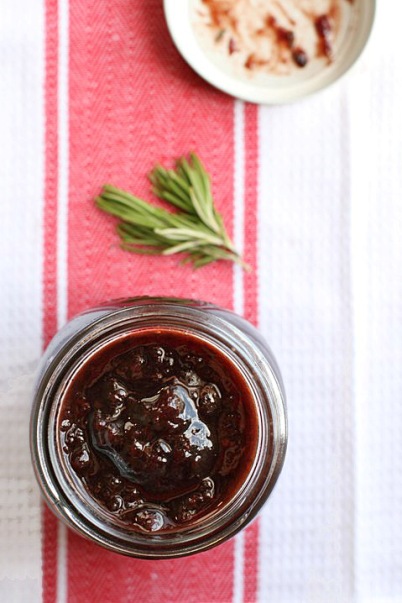
Plum Raspberry Rosemary Jam

Plum Jam with Rasberry and Rosemary

Since few years ago, the process of making jam at home and canning fruit and vegetables in general was intimidating. I remember clearly when my aunt used to simmer her own jam in a huge steel pot, so big that today it wouldn’t even pass through the door of my tiny kitchen. Every year towards the end of the summer she would buy large crates of peaches, apricots and plums, and prepare tons of jars that would last until the following year. The whole process would take her at least two days and it always seemed an impossible task to me. Not to mention the fact that I had no clue on the proper procedures to sterilize the jars, and I was afraid that even if I would eventually be able to make the jam, it would be useless because then I would have to face bacteria and molds.
Until one day I had a sudden revelation: to make jam you don’t need to buy 40 pounds of fruit and a human-size pot is perfectly fine. To tell you the truth, it’s even better to make small batches at a time, because you’ll get better results. It’s almost the same enlightenment I had with egg fettuccine. If you think about it, it doesn’t take long to make them, but for years the memory of my grandma working half a day in the kitchen just to roll out the dough has held me back. Obviously, when you have three generations of relatives over for lunch, it becomes quite a project, but with two simple eggs, how difficult is that?

My first trial was an orange marmalade, English style, with the whole peel inside. Absolutely delicious. And it was love at first sight. The entire process is just wonderful, from choosing the right fruit at Saturdays’ Farmers’ Market to the aroma that spreads all over the house while jam is on the stove. It’s a sort of country idyll in the middle of city traffic. The only downside is that it’s addicting: I haven’t even finished canning one, that I’m already thinking of the next combination of fruit. As a result, I don’t know where to store the jars anymore, and sometimes I wake up thinking I’m Grandma Duck!!

I owe this recipe to Daniela Cuzzocrea from the cooking forum of La Cucina Italiana (CI); as usual she is full of great ideas. I've reduced a bit the amount of sugar, since in general I don't like jams that are too sweet and I always try to use no more than 30% of sugar on the fruit's total weight. In addition, I usually add the peel of a couple of green apples, that I eventually discard once the jam is set. Being rich in pectin, they serve as natural thickener. When the jam is cooking, if I see that after 20 or 30 minutes it's still too liquid, I simply drain the fruit and keep it on the side, while the juice in the pot keeps boiling until it reaches the desired thickness. Then I throw in the fruit one more time, stir well and it’s done. This way I’m able not to overcook the jam, maintaining some of the fruit color and texture.
Breakfast is safe one more time : )


Plum Jam
with Raspberry & Rosemary


red plums 1.5 kg
raspberries 600 gr.
sugar 700 gr.
lemons 2
green apples (only the peel) 3
rosemary a couple of sprigs


Wash the plums, pit them and cut in small pieces. Put them in a large bowl together with the raspberries, add sugar and lemon juice and stir well. Cover with plastic and refrigerate overnight.
The next day, add apples' peel to the fruit, pour the mixture in a large pot and let it cook on a slow heat, skimming when needed, until jam reaches the desired thickness. Discard apples' peel, pour the jam in properly sterilized glass jars, cover with lids and let them boil in water for at least 20 minutes. Turn off the heat and let the jars cool in the same water to create the vacuum.